











Finding a Place Between the Lines
Feb 06
2026
By Katie Brickman via Hockey Canada
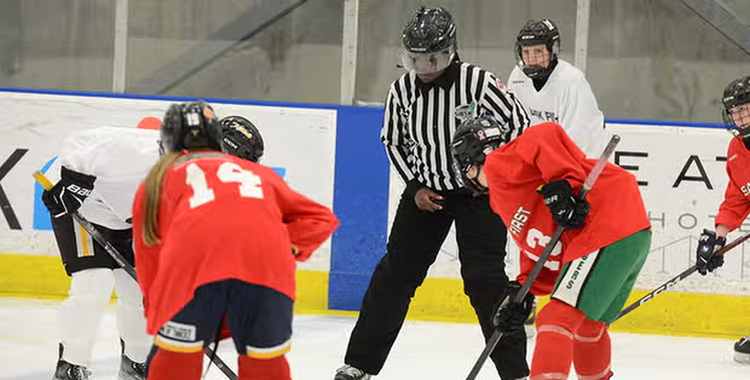
Like most kids born and raised in rural Saskatchewan, Nikia Schlosser grew up at the rink.
The 17-year-old started playing hockey as young as she could when her dad put her on skates and she’s been playing ever since.
“I like the community and the people you meet,” she says. “I like to play aggressive and getting to move my body and meeting different people in the community in a team atmosphere.”
A product of small-town Delisle, Saskatchewan (pop. 1,024), Schlosser currently plays for the Delisle Bruins in the U18 A division of the Saskatchewan Female Hockey League, leading the team with 10 goals and ranking second with 15 points in 15 games.
She has played defence, goaltender and on the wing before settling into her current role as a two-way centre.
“I like to float around a lot, but I just kind of stuck with centre,” Schlosser says.
That ability to try and play multiple positions has also helped Schlosser develop different skills and an understanding of the game that has complemented her as she moves into officiating.
“I think I started about four years ago. They were looking for officials in town and a couple of my friends were also trying it,” she says. “My first year wasn’t my favourite, but when a couple of my other friends started officiating, we got teamed up for more games and that’s when I really fell in love with it.”
She started as a referee but as she has moved up in leagues, she has enjoyed being on the lines more often.
Being in control of the game as referee has some benefits, but there are some downsides to hearing from players and coaches when a bad call happens.
“Getting frustrated with officials happens to everyone. Even when I’m officiating, people get frustrated with me and that’s understandable,” Schlosser says. “Just remember that my view of the game is different than yours and sight lines are different. Not everything is going to get called, but we try to see the whole play.”
As Schlosser spends more of her time as an official, she has been able to participate in some new and fun experiences, including a girls-only tournament in Prince Albert this year.
“I thought that was really cool seeing how far girls’ hockey has come and just how developed the players are and how they interact with each other and communicate on the ice,” she says. “They move the puck so well and their stamina is so strong. I thought it was a super cool learning experience.”
Schlosser has completed the Sask First Officiating Program, which is a high-performance development pathway for referees and linespersons in men’s, women’s and para hockey programs. It offers specialized coaching, mentoring and opportunities to officiate at higher-level regional camps and tournaments to advance skills and mechanics.
“Sask First is really cool. They have a regional camp the last week of January, but it pretty much is a showcase where you’re able to prove yourself to leaders and you can be selected for the program” she explains. “I was lucky enough in my first year to be selected and learned so much over those three days.”
Schlosser was able to participate in a power skating camp, work with different official pairings for games and get feedback from high performance coaches and officials.
“In my first year, we have Cianna Lieffers, Alex Foreman and Kate Sauser. After every period, they come in and talk to you and break down the game to help with body positioning and game development,” she says. “I think that’s where I have grown the most. The Sask First coaches take more time and care to make sure the game is running smoothly and just focus on your development as an official.”
As the high school senior looks ahead to her next steps, sports will be a critical component of her future. Now that there is a path for women’s hockey players with the creation and success of the Professional Women’s Hockey League, professional hockey is an option. But for Schlosser, she sees herself in stripes, rather than with a stick in her hand.
“If you asked me that a year ago, I do not think I would have ever said that. But I see myself as more of an official. I’ll be moving to Regina to go to the University of Regina for track and field. I’ll be living on campus, so I hope to be an official for higher games and eventually move to U SPORTS hockey.”
The ultimate goal would be to officiate at an Olympic Winter Games, but for now, Schlosser is focused on getting more into the university game.
There are over 2,000 registered women officials in Canada, but very few work at the Major Junior level or higher. But numbers are growing at the lower levels.
Many officials are white. Schlosser is Black and representation matters.
“You don’t see many Black females on the ice,” she says. “It is cool being seen. For a long time, I was the only Black kid in town and I was bullied for it, but now there are other Black kids in my community, and I think representation and being seen by the younger girls is important.”
As a Black girl on the ice, having confidence in herself is just as important as the support from family and friends. She is also comfortable enough in herself and her skin to encourage other Black girls to pick up the game.
“I think representation and being seen is important. I want to be an example for younger girls—you can do this,” she says. “I’ve always been a person to put myself into uncomfortable situations and just tough it out. The support I get from my family and friends is big for me to be who I am.”
Related Articles
Hockey Saskatchewan Recognizes 2025-26 Most Improved Officials
Officials Set for Summer Events

Hockey Saskatchewan Membership Presentation: September 2026 – WATCH
Hockey Saskatchewan Membership Presentation: September 2026 – WATCH
Members Invited to Share Feedback on U9 Hockey in Saskatchewan